In today’s digital world, businesses are constantly looking for smarter ways to reach the right people and grow faster online. But simply running ads is no longer enough. Brands now want marketing that delivers real, measurable results—whether that’s website traffic, leads, or actual sales.
That’s where performance marketing comes in.
Over the last few years, performance marketing has become one of the most powerful strategies for online growth. From startups and ecommerce brands to freelancers and large companies, many businesses now use it to track exactly what they spend and what they earn in return.
If you’ve ever wondered what performance marketing really means, how it works, and why it has become such an important part of digital marketing, this guide will walk you through everything in a simple and easy-to-understand way.
What Is Performance Marketing?
If you are interested in digital marketing, online business, or running ads online, you’ve probably heard the term performance marketing.
But many people still ask:
What is performance marketing exactly?
And honestly—it’s a very smart question.
Because the term sounds technical…
but the concept is actually very simple.
In easy words:
Performance marketing is a type of digital marketing where you pay only when a specific result happens.
That result could be:
- a click
- a lead
- a sale
- an app install
- email signup
- or another measurable action
This is what makes performance marketing different from traditional advertising.
Instead of paying only to show an ad…
you pay for actual performance.
And that’s why businesses love it.
How Performance Marketing Works
Let’s understand performance marketing with a simple example.
Imagine you sell a fitness supplement online.
You run an ad on Facebook.
Thousands of people see your ad.
But you only care about one thing:
Did someone buy?
If yes → campaign performed
If no → campaign needs improvement
That’s performance marketing.
Every result is measurable.
Everything can be tracked.
And every rupee spent can be analyzed.
Usually this process works like this:
Step 1 – Create an Offer
This could be:
- physical product
- digital product
- software
- online course
- service
- free trial
- lead form
Step 2 – Run Paid Traffic
Traffic is driven using platforms like:
- Facebook Ads
- Instagram Ads
- Google Ads
- YouTube Ads
- Native Ads
- Affiliate traffic
Step 3 – Track User Action
Then marketers track what people do.
For example:
- clicked ad?
- added to cart?
- purchased?
- filled form?
- downloaded app?
Step 4 – Optimize for Better Results
After checking data, marketers improve:
- ad creatives
- audience targeting
- landing page
- headline
- call to action
- budget strategy
Goal is simple:
Get maximum results with minimum cost.
Why Performance Marketing Is Important
Performance marketing is growing fast because businesses want measurable growth.
Nobody wants to spend money blindly.
Companies want numbers.
They want proof.
And performance marketing gives that.
Here’s why it matters:
1. Easy to Measure ROI
ROI means Return on Investment.
You can clearly see:
- how much spent
- how much earned
- profit generated
- cost per sale
This makes marketing decisions easier.
2. Lower Risk
Unlike traditional marketing…
you’re not paying only for visibility.
You’re focused on actions.
That means smarter spending.
3. Better Targeting
Performance marketing platforms allow advanced targeting.
You can target people based on:
- age
- gender
- interests
- behavior
- location
- device
- purchase history
This improves conversion rates.
4. Easy to Scale
Once a campaign becomes profitable…
you can increase budget and scale faster.
This is how many ecommerce brands grow quickly.
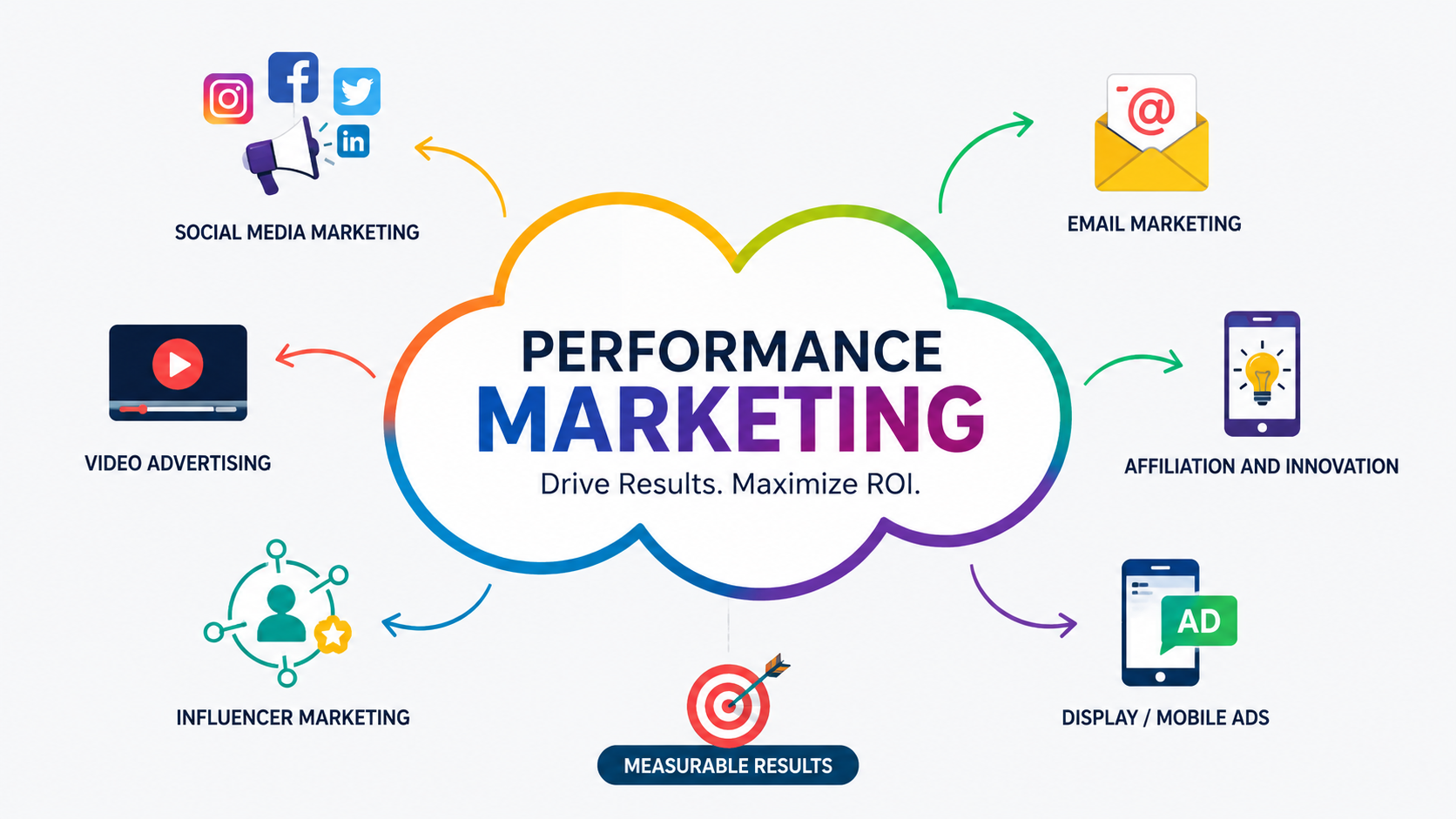
Main Types of Performance Marketing
There are multiple channels inside performance marketing.
Here are the most popular ones:
1. Paid Social Media Advertising
This includes ads on:
- TikTok
Businesses use these platforms for:
- sales
- leads
- traffic
- brand awareness
- app installs
Facebook and Instagram are especially popular for ecommerce brands.
2. Search Engine Marketing (SEM)
This mainly includes Google Ads.
Example:
Someone searches:
“best running shoes for men”
Your ad appears.
If user clicks → you pay.
This is called PPC (Pay Per Click).
3. Affiliate Marketing
Affiliate marketing is one of the biggest parts of performance marketing.
A person promotes a product using their affiliate link.
When someone buys—
they earn commission.
No sale = no commission
That’s pure performance marketing.
4. Influencer Performance Campaigns
Many brands now work with influencers on performance basis.
Instead of paying fixed fees…
they pay per:
- sale
- lead
- coupon code conversion
This reduces brand risk.
Important Performance Marketing Metrics
Performance marketing depends heavily on numbers.
Here are the key metrics marketers watch daily:
CTR (Click Through Rate)
Shows how many people clicked after seeing your ad.
Higher CTR usually means stronger ad creative.
CPC (Cost Per Click)
How much you pay for one click.
Lower CPC often means cheaper traffic.
CPA (Cost Per Acquisition)
How much it costs to acquire one customer.
Very important for profitability.
Conversion Rate
Shows how many visitors actually buy or complete action.
Higher conversion rate means better campaign performance.
ROAS (Return On Ad Spend)
One of the most important metrics.
Example:
Spend $100 on ads
Generate $400 in sales
ROAS = 4x
Very useful for ecommerce businesses.
Performance Marketing vs Traditional Marketing
This is where many beginners get confused.
Here’s the simple difference:
Traditional Marketing
Examples:
- newspaper ads
- TV ads
- radio ads
- billboards
Problem:
Results are difficult to measure accurately.
Performance Marketing
Everything is measurable:
- clicks
- sales
- leads
- conversions
- ROI
That’s why digital businesses prefer performance marketing today.
Who Should Use Performance Marketing?
Performance marketing works for almost every online business.
It’s especially useful for:
- ecommerce brands
- affiliate marketers
- coaches
- freelancers
- agencies
- SaaS companies
- local businesses
- course creators
- startups
If your goal is leads or sales online—
performance marketing can help.
Is Performance Marketing Good for Beginners?
Yes—100%.
Even beginners can start.
You don’t need a huge team.
You don’t need a big office.
You don’t need massive budget.
You simply need:
- a product or service
- traffic source
- landing page
- good ad creative
- proper tracking
Then testing begins.
That’s where learning happens.
Final Thoughts
So, what is performance marketing?
In simple words:
Performance marketing is a digital marketing strategy where advertisers pay based on actual measurable results like clicks, leads, or sales.
It’s one of the most powerful growth strategies in online business today.
Because it’s:
- measurable
- scalable
- data-driven
- ROI-focused
Whether you run:
- Facebook Ads
- Google Ads
- ecommerce store
- affiliate offers
- online services
learning performance marketing can help you grow faster online.
And in 2026…
it’s one of the most valuable digital skills anyone can learn.
If you’re building an online business, this is absolutely worth understanding.
Because good marketing gets attention…
but performance marketing gets measurable results.